
Question submitted by: Fatimah – 15 October 2011
In the Name of Allah, the Most Compassionate, the Most Merciful.
All praise belongs to Allah, Lord of the worlds. Praise be to Allah as befits His Majesty. May Allah send blessings upon the Chosen and Trustworthy Prophet Muhammad, his pure and immaculate Family, and his chosen Companions.
Respected Scholar,
Peace and Allah’s mercy and blessings be upon you.
The Truthful and Trustworthy Muhammad ﷺ said:
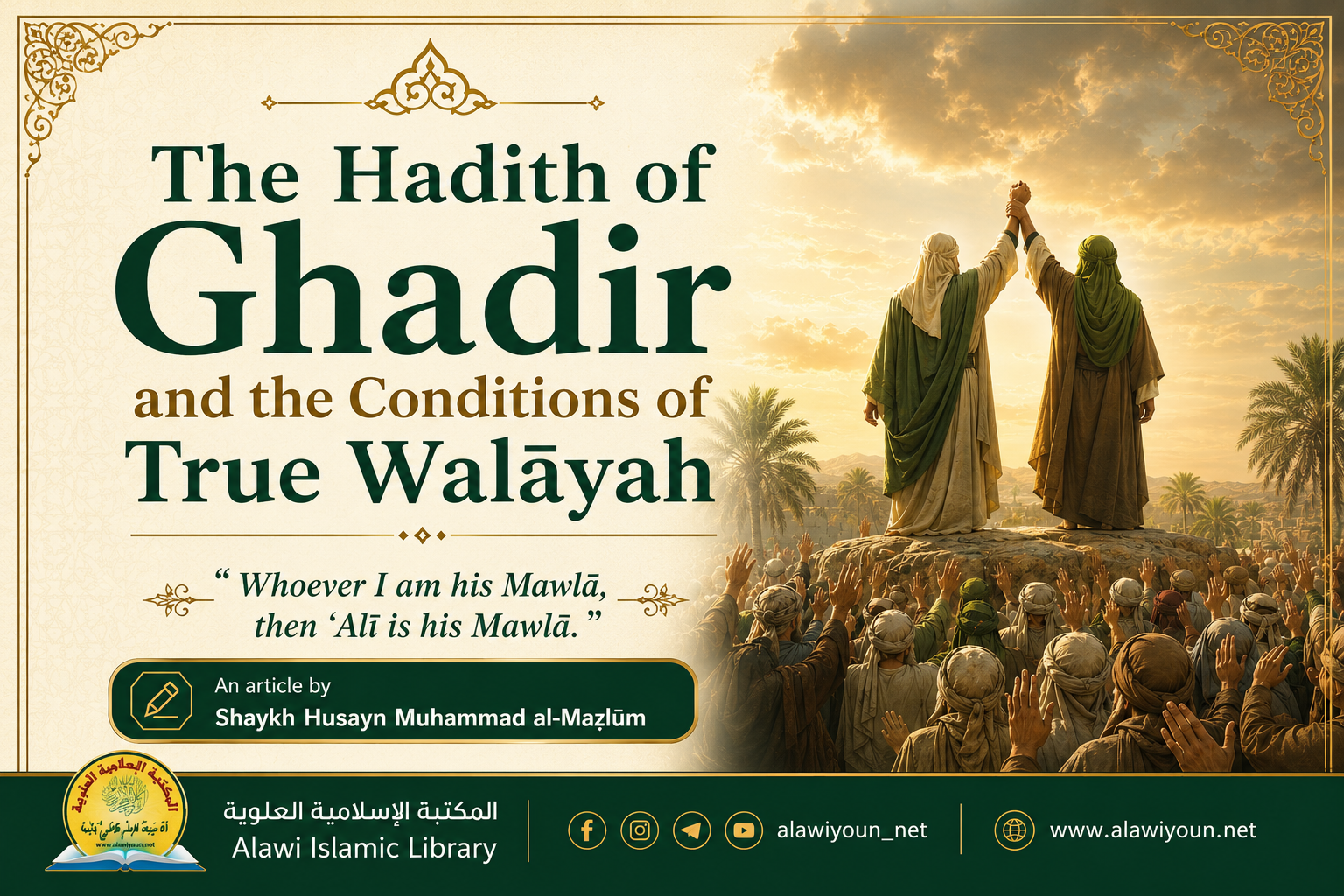
“Whoever I am his Mawlā, then ʿAlī is his Mawlā. O Allah, befriend whoever befriends him and oppose whoever opposes him.”
How should we understand this noble tradition?
How can a person know whether he is truly among the followers and supporters of the Commander of the Faithful, Imam ʿAlī (peace be upon him)?
Is love for the Commander of the Faithful and the Imams (peace be upon them) sufficient on its own to make us among their followers? In other words, how does one become a true adherent of their walāyah?
How can a person evaluate his faith and righteousness and know that he is upon the right path, rather than among those described by the Qur’anic verse:
“Those whose efforts in the life of this world have gone astray while they think that they are doing good.”
All praise belongs to Allah, Lord of the worlds.
The Answer
In the Name of Allah, the Most Compassionate, the Most Merciful.
May Allah send blessings and peace upon Muhammad and his Family.
This tradition has reached the level of widespread transmission and mass narration (tawātur). It is the famous tradition of walāyah proclaimed on the Day of Ghadir, and whose foundations were established even earlier on the Day of the Covenant and Primordial Testimony, as indicated by reliable narrations.
To understand it correctly and comprehensively, we must approach it through a systematic method supported by evidence.
The one speaking and conveying this message is the Prophet of the Ummah ﷺ, who says: “Whoever I am his Mawlā…”
This opening statement serves as an introduction clarifying the meaning of wilāyah itself.
What, then, is this wilāyah?
Allah the Exalted says: “The Prophet has greater authority over the believers than they have over themselves.” (Qur’an 33:6)
This verse indicates that the Prophet possesses a greater claim over the believers than they possess over themselves. Consequently, he has authority over them in matters both religious and worldly. His wilāyah is complete and comprehensive, and the duty of the believer is complete obedience and full submission.
From this we understand the wisdom behind the Prophet’s introduction before reaching the main purpose of his statement. He first explained the meaning of authority and guardianship through his own relationship with the believers, and only then conveyed to them the wilāyah of the Commander of the Faithful by saying: “Whoever I am his Mawlā…” Meaning: “Then ʿAlī is his Mawlā.”
With the same comprehensive meaning, without distinction, separation, or diminution.
The Prophet ﷺ then proceeds to explain the virtue and consequences of this walāyah, saying in supplication: “O Allah, befriend whoever befriends him.”
The Messenger of Allah ﷺ, whose supplications are accepted, invokes Allah, the Most High, to bestow abundant goodness and tremendous success upon those who truly uphold the walāyah of Imam ʿAlī — provided they fulfil its conditions.
He then says: “And oppose whoever opposes him.”
This, in turn, represents the gravest loss for the one who rejects or denies this walāyah.
Among the foremost conditions of wilāyah is loyalty to the friends and followers of Imam ʿAlī and disassociation from his enemies.
The Commander of the Faithful once entered upon a group of his followers and asked: “Do you claim that you have attained our walāyah?”
They replied: “Yes, our master.”
He said: “No, by Allah — not unless you befriend our friends and oppose our enemies.”
This meaning is further reinforced by the saying of the Noble Messenger ﷺ:
“None of you truly believes until I become more beloved to him than his own self, and my family more beloved to him than his own family.”
This greatest condition for the acceptance of walāyah must be accompanied by walking upon the path of the Infallible Ones — in belief, in conduct, and in practice — without departing from their guidance in matters great or small.
As for how a person may know whether he is truly among the followers of Imam ʿAlī, the answer is found in the words of Imam al-Ṣādiq (peace be upon him):
“Whoever among you finds the coolness of our love within his heart should thank Allah for the greatest of blessings.”
The narrator, Isḥāq ibn ʿAmmār, asked: “And what is the greatest of blessings?”
The Imam replied: “Purity of birth.”
Thus, whoever's birth and origin are pure, his upbringing will be pure; and whoever's upbringing is pure is among the followers of Ḥaydar (Imam ʿAlī).
Imam al-Ṣādiq (peace be upon him) also said:
“Allah created Paradise pure and purified, and none shall enter it except one whose birth is pure.”
And Imam al-Bāqir (peace be upon him) said:
“Whoever's birth is pure shall enter Paradise.”
Accordingly, that spiritual joy and inward delight which a believer experiences when the Commander of the Faithful is mentioned is felt only by one whose origin is pure. It is a sign of a sound beginning and a reflection of the covenant established in the primordial world.
Yet love for Imam ʿAlī is not merely a verbal expression, nor is it sufficient by itself.
For sincerity of devotion is a condition for the validity of one's claim.
The greater a person's commitment to following the Imam, the greater his rank and success.
As for knowing whether one is upon the right path, the criterion is clear:
A person must examine his words and deeds.
If they conform to the Book of Allah, the Sunnah of the Prophet ﷺ, and the guidance of the Infallible Ones, then he is upon goodness.
Otherwise, he is not.
Whoever loves Imam ʿAlī and follows his comprehensive Islamic path is indeed among his followers.
This requires no further proof, for both reason and revelation testify to it.
And every blessing you possess is from Allah.
May Allah keep you in goodness and well-being.
Husayn Muhammad al-Maẓlūm.
16\10\2011
- 5397 views